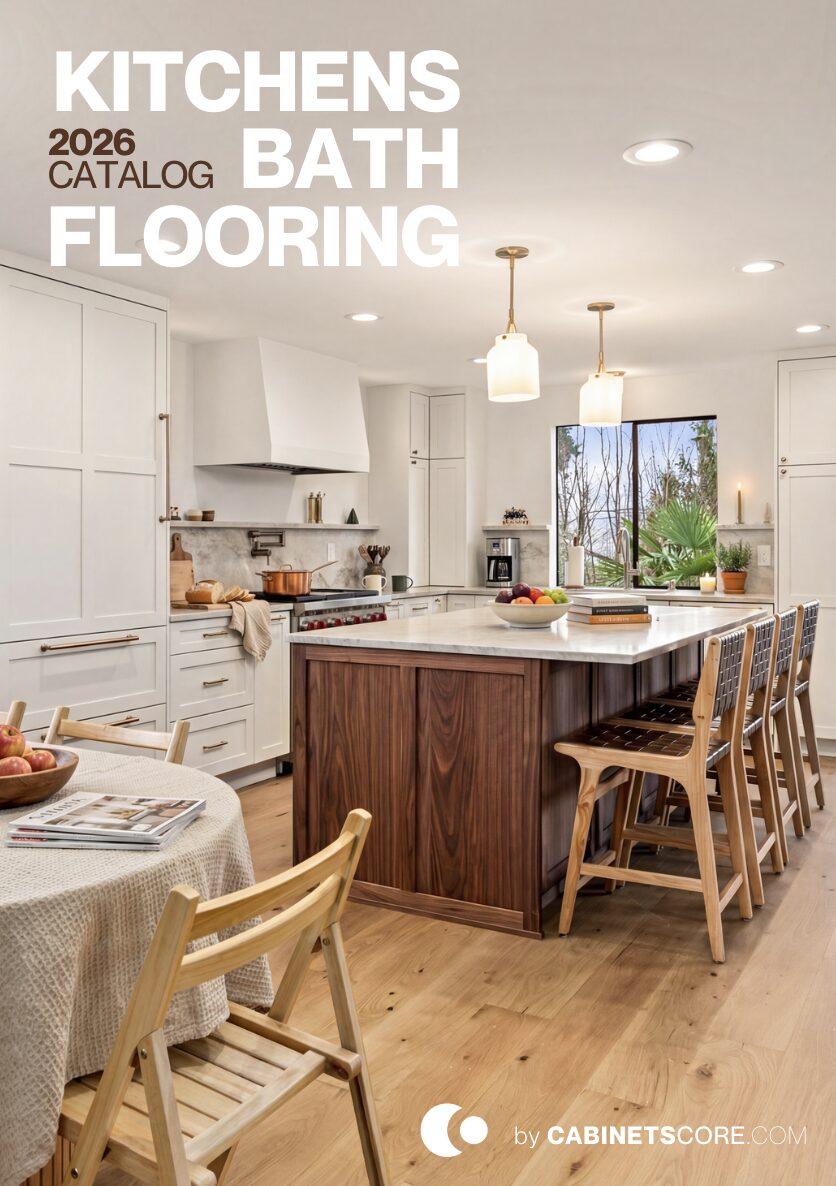
Lake Tapps Kitchen Renovation — Off-White Shaker, Alton Iced Mocha Island & Mixed-Metal Hardware
Marble-Look Quartz, Subway Tile Backsplash & a Built-In Coffee Station
The Lake Tapps kitchen started as a textbook builder-grade space — generic raised-panel cabinetry, black laminate counters, a basic white island that didn’t earn its place in the room, and the kind of overhead lighting that flattens everything beneath it. The renovation kept the footprint and changed everything else. Same room, completely different kitchen.
This was a renovation, not a structural remodel. The walls stayed where they were. What changed: every cabinet, every counter, the backsplash, the hardware, the appliances, and the addition of a built-in coffee station that used to be just wall space.
Why the Uppers Go to the Ceiling
The single biggest visual decision in this kitchen is something most homeowners don’t notice consciously: the wall cabinets run all the way up. No soffit, no awkward gap, no row of decorative items collecting dust on top.
Standard upper cabinets stop short of the ceiling because it’s cheaper to install and easier to standardize. The downside is a strip of dead space that always looks unfinished. Running cabinets to the ceiling does three things: it adds real storage at the top (deep seasonal items you don’t need often), it makes the room feel taller because the eye travels up the full wall, and it eliminates the visual break that makes most kitchens look “almost done.” It costs more in cabinetry and trim. For a kitchen meant to read as designed, it’s the right call.
The Island Is the Whole Renovation
The single decision that transforms this room is the warm-stained wood island (Alton Iced Mocha in birch, finished in a golden brown stain). Strip that island out and replace it with another white piece — like the original — and the kitchen reads as “renovated white kitchen.” Put the wood island in, and the room has a focal point and a personality.
The reason it works: the rest of the kitchen is deliberately quiet. Off-white shaker on the perimeter, marble-look quartz counters, white subway tile backsplash, no competing wood tones anywhere else in the room. The island gets to be the loudest thing in the kitchen because nothing else is fighting for that role. This is the rule for high-contrast feature pieces in a renovation: pick one element to carry the weight, then make every other choice support it instead of competing with it.
Off-White, Not Pure White — Why It Matters
The cabinets are off-white, not pure white. That’s a deliberate call and worth explaining because most homeowners default to bright white.
Pure white cabinets read clinical in a kitchen with mixed natural light — they go slightly blue under cool morning light and slightly yellow under warm evening light, and the inconsistency can make the room feel unsettled. Off-white (with a hint of warmth in the paint) stays consistent across lighting conditions and pairs better with wood elements. In a kitchen with a strongly stained wood island like this one, pure white perimeter cabinetry would have created a cold-warm split — the island would look like it didn’t belong. Off-white meets the wood halfway and makes the two-tone combination read as a relationship, not a contrast.
Brass Hardware Meets Matte Black — A Specific Combination
The hardware in this kitchen mixes brass and matte black with a specific rule: brass on the cabinet pulls and knobs, matte black on the plumbing and appliances. The dishwasher, the faucet, and the integrated appliances are matte black; the cabinet hardware is uniformly brass.
The rule works because each metal has a defined zone. Brass at cabinet level reads as warm, tactile, and decorative — appropriate for the part of the kitchen you actually touch. Matte black on plumbing and appliances reads as functional and modern, and it grounds the lighter cabinetry visually. Mixing them randomly would look indecisive; assigning each finish a structural role makes the combination read as designed. This is how mixed metals work without looking like a mistake — give each finish a job, then stick to it across the whole kitchen.