Sumner Home Renovation — Bright White Shaker Cabinetry Across the Whole House
Marble-Look Quartz, Brass Pulls & Matte Black Plumbing
This Sumner home used a single cabinet line — Bright White Shaker — across every cabinetry-bearing room in the house. Kitchen, mudroom, laundry, and both bathrooms all use the same door style, the same finish, the same construction. The variation between rooms comes from everything else: hardware, counters, tile, plumbing finishes, and how each room handles its own light.
This was a renovation, not a structural remodel. What changed: every cabinet, every counter, every plumbing fixture, and the visual logic that ties five separate rooms into one coherent home.
Why One Cabinet Line Across the Whole House
Most whole-home renovations end up looking piecemeal because each room gets specified separately — different cabinet styles, different finishes, different vendors. The kitchen has shaker, the bathroom has flat-panel, the laundry has builder-grade boxes. Each room is fine on its own, but the house never quite feels like one project.
Running a single cabinet line across every room solves that problem at the source. The shaker door in the master bath reads as part of the same house as the shaker door in the kitchen, even though everything around them is different. The continuity is unconscious — homeowners don’t actively notice it, but the home feels more “designed” than a comparable project with mixed cabinet styles. There’s also a practical benefit: you order in one batch, you coordinate one round of cabinet installation, and you don’t end up with three slightly different shades of off-white because the manufacturers don’t quite match.
Bright White, Not Cream or Off-White
The cabinets here are bright white — clean, crisp, no warm undertone. That’s a deliberate choice for this home and worth distinguishing from the off-white we used on the Lake Tapps project.
Bright white is the right call when the surrounding light is warm and the home has plenty of windows. In a home with cool gray light and dim interiors, bright white cabinets can read as cold or clinical — they need warm light to come alive. This home has large windows, light oak floors, and natural light throughout, so the bright white cabinetry stays crisp without going sterile. It also gives the brass hardware more visual contrast to work with. Bright white plus brass is one of the more reliable combinations in modern design; bright white plus matte black hardware is the alternative when you want the room to lean industrial instead of warm.
How Each Room Gets Its Own Identity Without Breaking the Pattern
The cabinets are the same in every room. Everything else changes, and that’s what gives each space a distinct character without breaking the home’s overall design language.
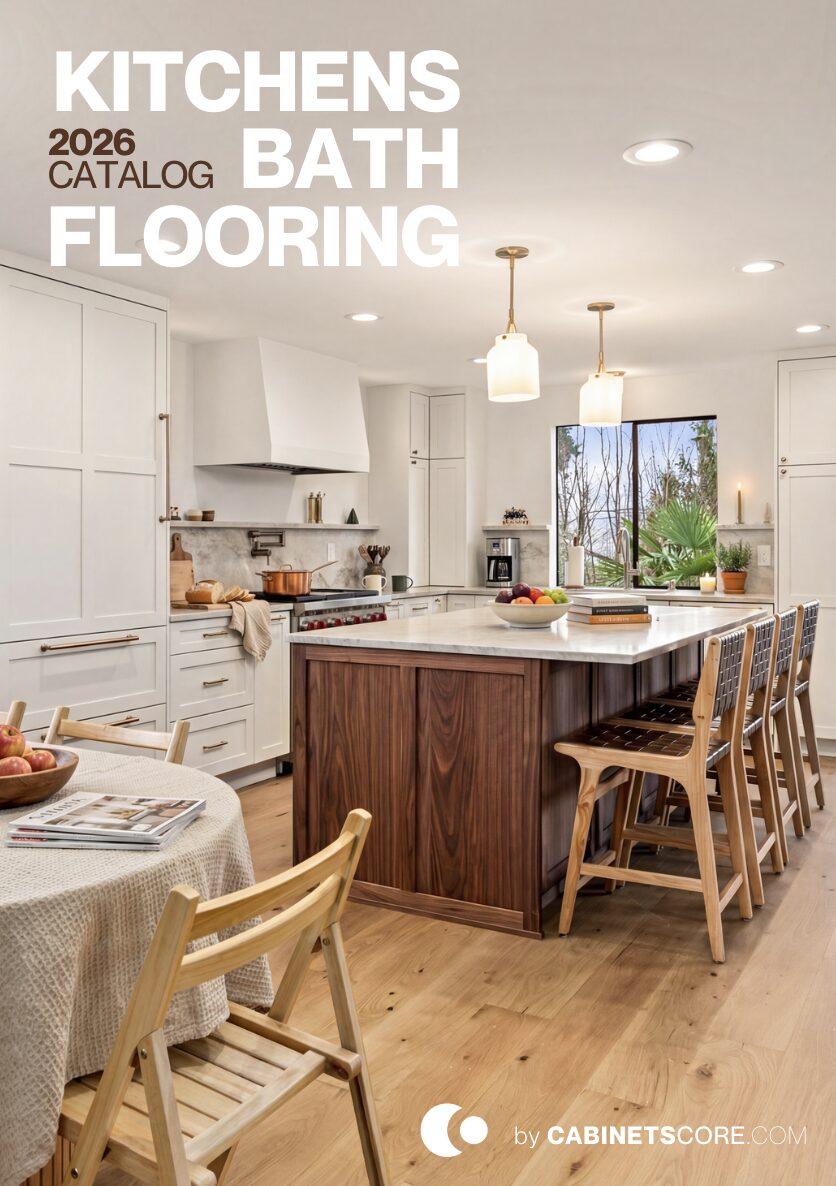
The kitchen leans warm — brass hardware throughout, light oak floors, marble-look quartz counters, a linear pendant over the island that puts warm light on the workspace. The bathrooms flip the contrast: matte black plumbing instead of brass, marble-look slab surfaces on the walls (with one bathroom using a striking green-veined stone that becomes the room’s focal point), and chrome or crystal lighting that reads cooler and more formal. Same cabinetry, completely different mood. The laundry and mudroom stay simple — same hardware as the kitchen, same general feel, but with utility-grade tile floors and minimal decoration. The pattern is: cabinetry stays constant, everything else adapts to what the room is actually for.
The Mudroom Bench Is the Detail That Sells the Project
Most whole-home renovations stop being thoughtful at the utility rooms. The kitchen gets the budget and the design attention; the mudroom gets builder-grade cabinets and a coat hook. This home went the other direction — the mudroom uses the same Bright White Shaker cabinetry as the kitchen, with a built-in bench that runs the length of the wall, integrated storage underneath, and hexagonal tile flooring that reads as deliberate rather than utilitarian.
This is the call that distinguishes a whole-home renovation from a kitchen renovation with bonus rooms. The decision rule: every room you walk through daily deserves the same level of finish as the rooms you photograph. Mudrooms, laundries, and entry zones get used more often than dining rooms, and treating them as primary spaces (not afterthoughts) is what makes a house feel finished rather than partly finished.