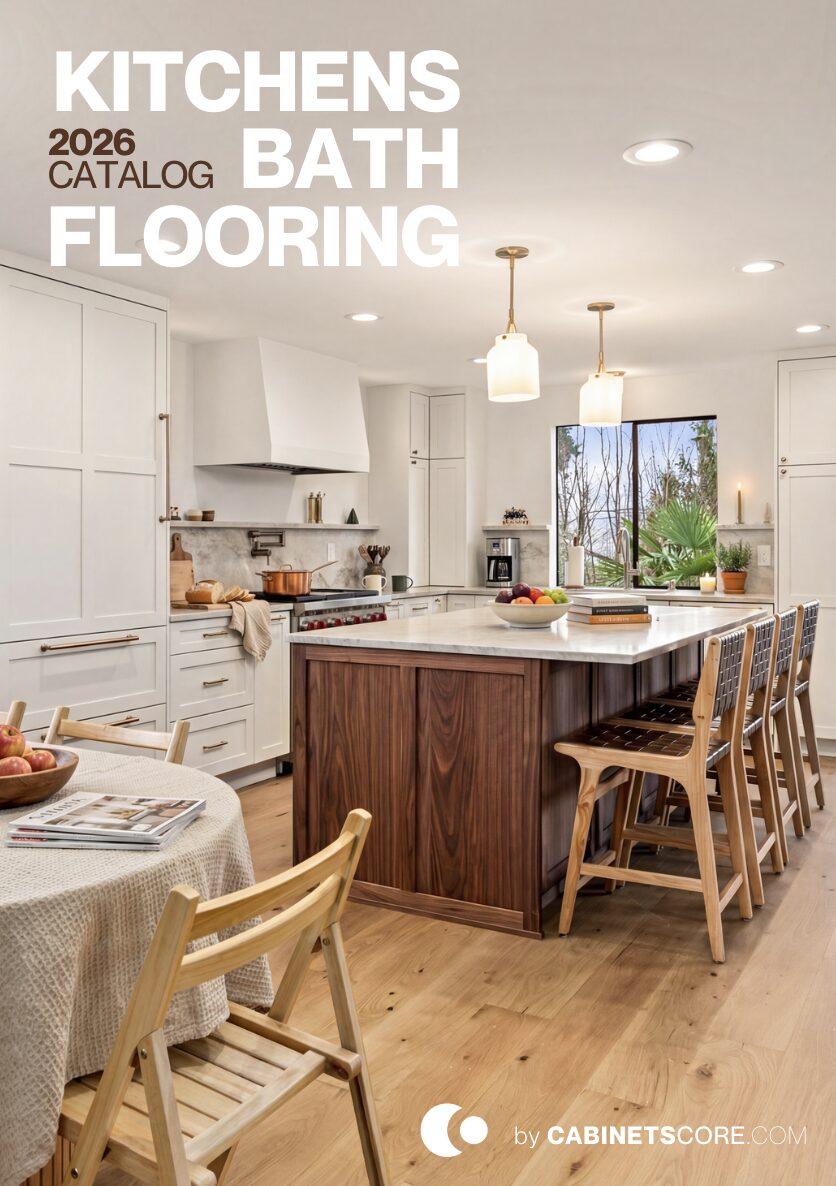
Seattle Kitchen Renovation — White Shaker, Walnut Slat Island & Black Stone Counters
Coordinated Bathroom Vanities, Hexagon Backsplash & Mixed Metal Hardware
The kitchen and bathrooms in this Seattle home were renovated together as one design — same cabinetry line, same finish family, same hardware decisions carried across rooms. That’s the move that turns three separate renovations into one coherent project, and it’s the single decision that has the biggest impact on how the finished home feels.
This was a finish-level renovation, not a structural remodel. The footprints stayed the same. What changed: every cabinet, every counter, every fixture, and the visual logic that ties them together.
The Island Is the Whole Room
The kitchen has a single design move that does most of the work: a walnut-slat island topped with black soapstone-look stone, set against an otherwise quiet white shaker perimeter. Strip that island out and the room reads as a standard white kitchen. Put it in, and the whole space gets a focal point and a personality.
The vertical slat detail on the island matters more than people expect. Flat-panel walnut would have read as a wood box dropped into a white room. The vertical slats add texture and rhythm — they catch light differently from every angle, which is what gives the island depth instead of flatness. It’s the kind of detail that costs slightly more in cabinetry and pays back in how the room feels in person versus in photos.
Why Black Stone on the Island, White Quartz on the Perimeter
Mixing countertop materials between island and perimeter is one of those decisions that sounds risky and almost always works. The reasoning is functional, not just aesthetic.
The perimeter does the heavy prep work — chopping, rolling, hot pans set down briefly. White quartz handles that abuse without showing wear, and it bounces light into the back of the kitchen where the windows can’t reach. The island is the social surface — bar seating, serving, displaying. Black stone reads as a focal point and visually anchors the island as a separate feature rather than just more counter. Same material on both surfaces would have flattened the room into a single visual zone.
The Bathroom Cabinets — Same Family, Different Job
Both bathrooms use white shaker vanities — same door style as the kitchen perimeter cabinets, deliberately. That repetition is what makes the bathrooms read as part of this house rather than separate rooms with separate design choices.
What’s different in the bathrooms: the hardware leans into matte black (where the kitchen mixed in brass), the counters use marble-look quartz to brighten smaller windowless spaces, and the vanity scale stays modest — no oversized furniture-style pieces competing with the rest of the room. The rule we apply: pick one or two materials to carry across every room of a multi-room renovation, and let everything else be specific to each space. In this project, the white shaker door is the carry. Everything else adapts.
When Coordinated Renovations Are Worth It
Doing a kitchen and bathrooms as one renovation project costs more upfront than doing them separately, but it’s almost always cheaper than doing them in sequence over a few years. You order cabinetry from one line, you coordinate one round of trades, you order tile and hardware in batches that get bulk pricing. More importantly: you make design decisions once, across rooms, instead of trying to match a new bathroom to a two-year-old kitchen later.
If you’re planning a kitchen and bath renovation in Seattle and want the rooms to feel like one project rather than three, Cabinets Core can walk you through how to coordinate cabinet lines, hardware finishes, and material choices across the whole scope — without making every room look identical.