
Quartz is the surface our clients ask for by name more than any other — and it’s also the one they understand the least. Most homeowners arrive knowing two things: it looks like stone, and it’s “low maintenance.” Both are true. But the decision to put quartz in your kitchen or bath comes down to details nobody mentions in a showroom: how it’s actually built, the one thing that will damage it, and whether your cabinets can carry it.
This is the guide we wish every client read before they picked a slab.
What Are Quartz Countertops Made Of?
Here’s the short answer that surprises people: quartz countertops aren’t quarried. They’re built.
A finished slab is roughly 90–93% ground natural quartz, blended with 7–10% polymer resin and pigment, then compressed under heat and vacuum into a dense, uniform surface. Some lines mix in recycled glass or metallic flecks for character. That manufacturing step is the whole story — it’s why every quartz advantage and every quartz limitation exists.
The natural quartz gives the slab its scratch resistance. The resin does two jobs at once: it makes the surface non-porous (so liquids sit on top instead of soaking in) and it adds flexural strength that helps the edges resist chipping. But that same resin is also the material’s weak point when it meets direct heat — more on that below.
So when people call quartz “engineered stone,” they mean it literally. You’re getting the look and hardness of natural rock with the consistency and zero-maintenance behavior of a manufactured product.
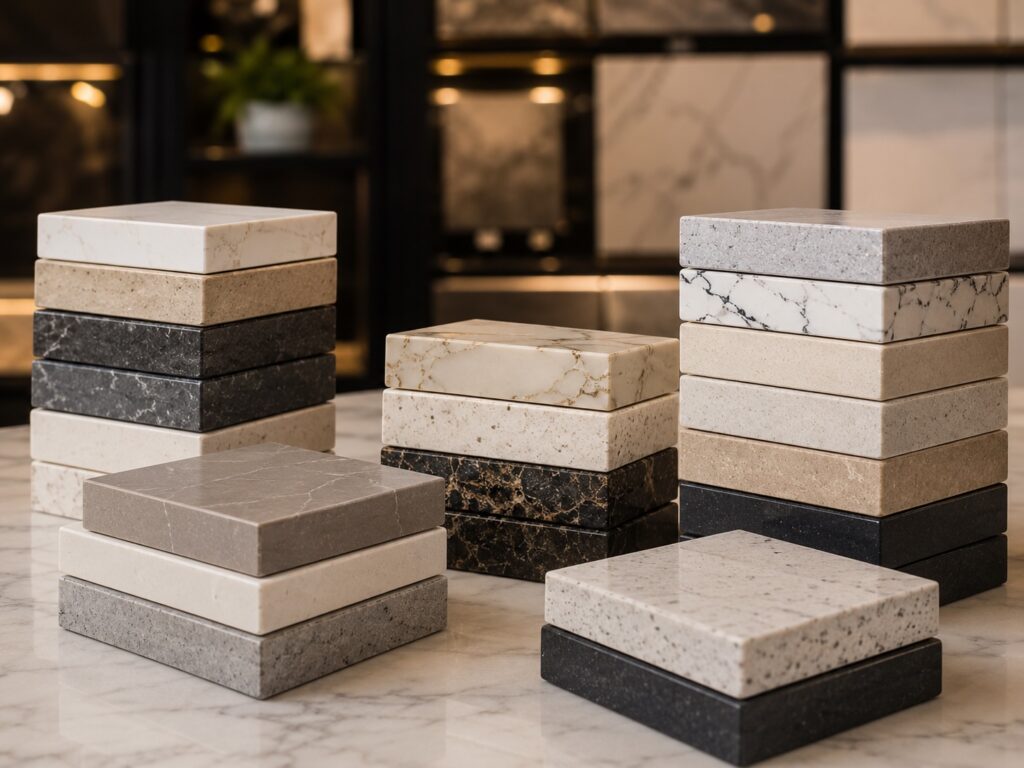
The Four Questions That Actually Decide If Quartz Is Right for You
Forget the feature list for a second. In our experience, whether quartz is the right call comes down to four honest questions about how you live.
1. Do you cook like you mean it?
If your counters take a beating — knives, pots, daily spills, kids doing homework over a snack — quartz is built for exactly that. It shrugs off scratches and the non-porous surface means red wine, coffee, and tomato sauce wipe clean instead of staining. This is the use case where quartz outperforms granite and marble most clearly.
2. Can you keep a hot pan off the surface?
This is the dealbreaker question. The resin in quartz tolerates warmth but not direct, intense heat. A pan straight off the burner or a curling iron left on a bathroom vanity can leave a permanent scorch mark. If trivets and hot pads aren’t a habit you’ll keep, that’s worth knowing before you commit.
3. Is the space indoors and out of direct sun?
UV light slowly fades and yellows resin. Quartz is an indoor material — full stop. Beautiful in a kitchen or windowed bath, a poor choice for a sun-blasted breakfast nook or any covered patio.
4. Are your cabinets ready to carry it?
Quartz is heavy: about 20 pounds per square foot. That weight needs level, structurally sound base cabinetry, or you’ll see shifting and uneven seams down the road. We assess and reinforce cabinet bases during planning for exactly this reason — it’s the step DIY installs skip, and it’s the most common source of callbacks.
Answer those four honestly and you’ll know whether quartz fits before you’ve spent a dollar.
What Quartz Is Like to Live With
The day-to-day reality is the part most people fall in love with.
There’s no sealing, ever. No special polishes, no annual maintenance ritual, no worrying that an acidic spill is quietly etching your investment. Soap and water handles it. Because nothing soaks in, the surface doesn’t harbor moisture or bacteria — which matters in a humid Pacific Northwest kitchen and even more in a bathroom around sinks and showers.
It’s also predictable in a way natural stone simply isn’t. Granite and marble vary slab to slab; quartz delivers the same color and pattern across your island, perimeter counters, and vanity. For a project tying multiple surfaces together, that consistency is the difference between “designed” and “close enough.”
And when you eventually sell, quartz reads to buyers as a surface that won’t need replacing — one of the few remodel choices that’s both practical to live with and persuasive on the market.
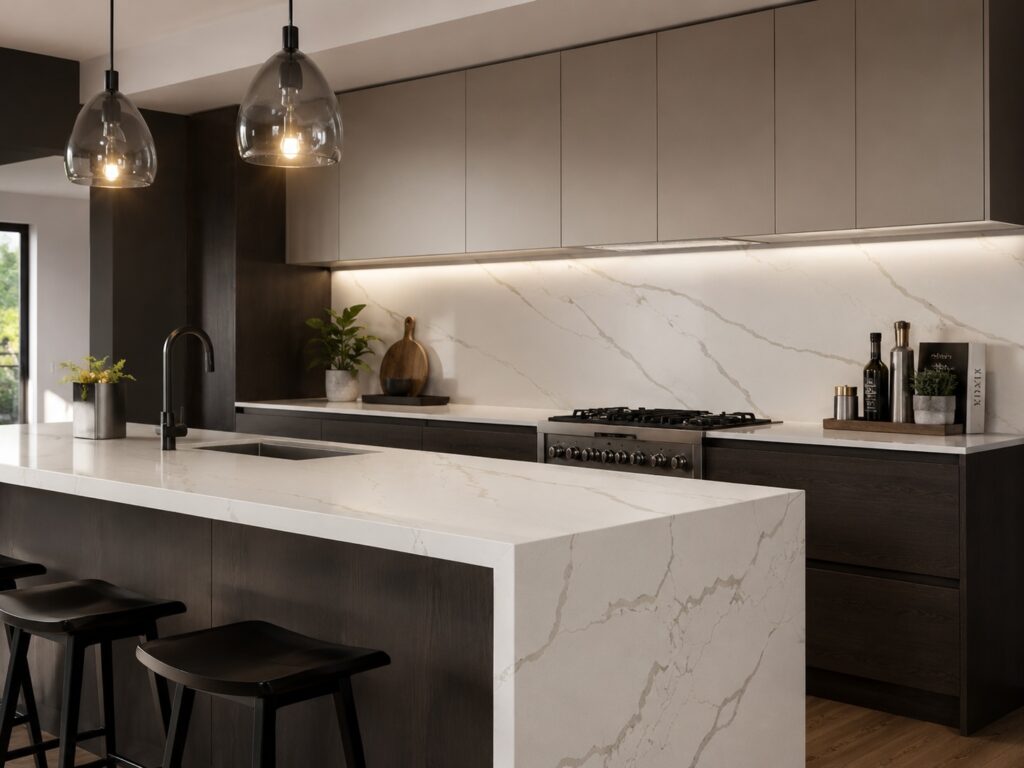
The Trade-Offs Worth Planning Around
We’d rather you hear these from us than discover them later:
- Heat is the real enemy. Not water, not scratches — heat. Plan for trivets.
- Big layouts show seams. U-shaped runs and full-height backsplashes usually need them. A skilled fabricator places and aligns seams thoughtfully, but up close they’re visible.
- It’s a mid-to-premium price. Most slabs run $60–$100 per square foot installed, with waterfall edges and intricate patterns pushing higher. Countertops are typically a top-three line item in any remodel.
- Installation isn’t a weekend project. Between the weight, the leveling, and the cabinet prep, this is professional territory.
Quartz vs. Granite vs. Marble, at a Glance
| What matters | Quartz | Granite | Marble |
|---|---|---|---|
| Sealing required | Never | Periodic | Frequent |
| Stain resistance | High | Moderate | Low |
| Heat tolerance | Moderate — use trivets | High | Moderate |
| Pattern consistency | Identical slab to slab | Varies | Varies |
| Upkeep | Minimal | Moderate | High |
“Is the silica thing something I should worry about?”
Clients ask, so we’ll answer plainly: the health concern around engineered stone (silicosis) applies to fabrication — the cutting and polishing — not to a finished countertop in your home, which is completely inert and safe. We address it on our end by sourcing from reputable U.S. suppliers and partnering with fabricators who follow proper dust-control practices. If responsible sourcing is on your mind, raise it with us directly; it’s a conversation we welcome.
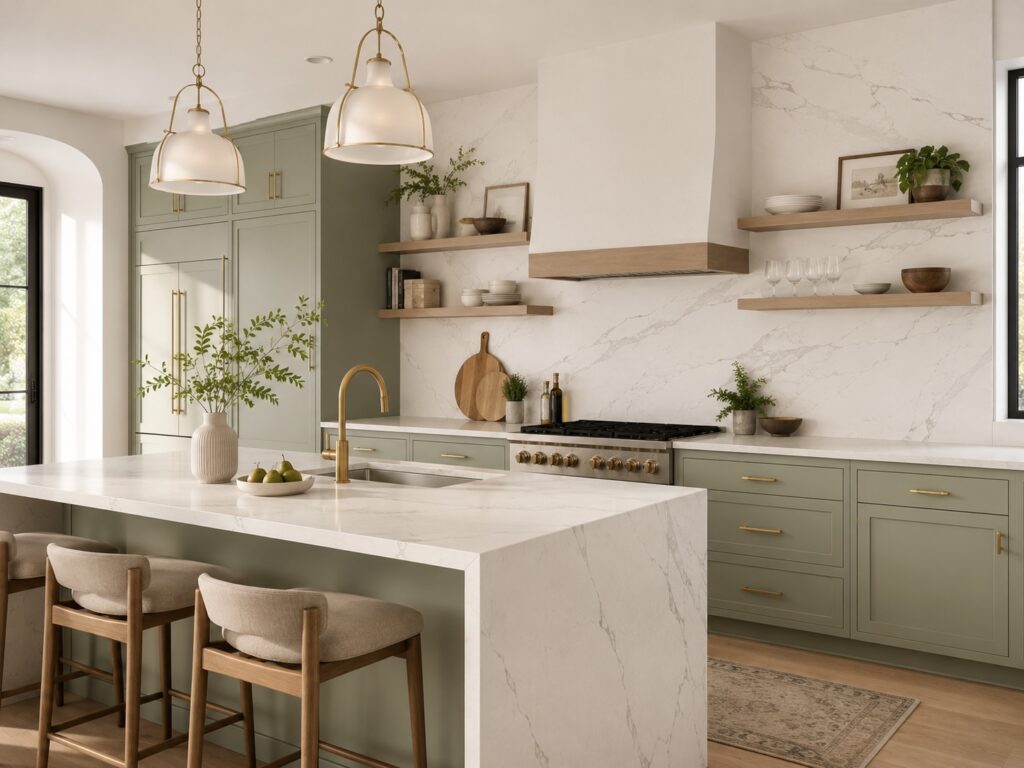
What Quartz Costs in a Pacific Northwest Remodel
Treat these as planning ranges, not quotes — your number depends on layout, edge profile, and finishes:
- Quartz material, installed: $60–$100 per square foot
- Mid-range bathroom remodel (Bellevue/Seattle): commonly $10,000–$25,000, climbing for larger or luxury baths
- Full kitchen renovation: from the low $60,000s into six figures for high-end work
Countertops are a meaningful slice of either total, which is exactly why it pays to choose a surface you won’t be replacing in five years.
Quartz Countertop FAQ
Does quartz ever need sealing? No. The non-porous surface means no sealing for the life of the counter.
Can I set a hot pan directly on it? No — use a trivet. Direct, intense heat can scorch the resin permanently.
How long will quartz last? Decades with normal care. It rarely needs repair and doesn’t degrade the way porous stone does.
Is quartz a good fit for bathrooms? Yes. Its moisture resistance makes it ideal for vanities and wet areas.
Will quartz fade? Indoors, no. In direct sunlight over time, the resin can yellow — which is why it’s an interior material.
Pick the Right Slab With Cabinets Core
Quartz earns its popularity: tough, consistent, almost maintenance-free, and forgiving of real life — as long as you respect the heat and keep it indoors. For nearly every interior kitchen and bath, it’s a surface that looks new for years and quietly does its job.
At Cabinets Core, we don’t just hand you samples. We assess your cabinetry, plan your seams, source responsibly, and install it to last. If you’re weighing quartz for a remodel, let’s talk through your space and find the slab that’s right for it.